The Two Stories of a Half-Empty Plate
2025-10-01
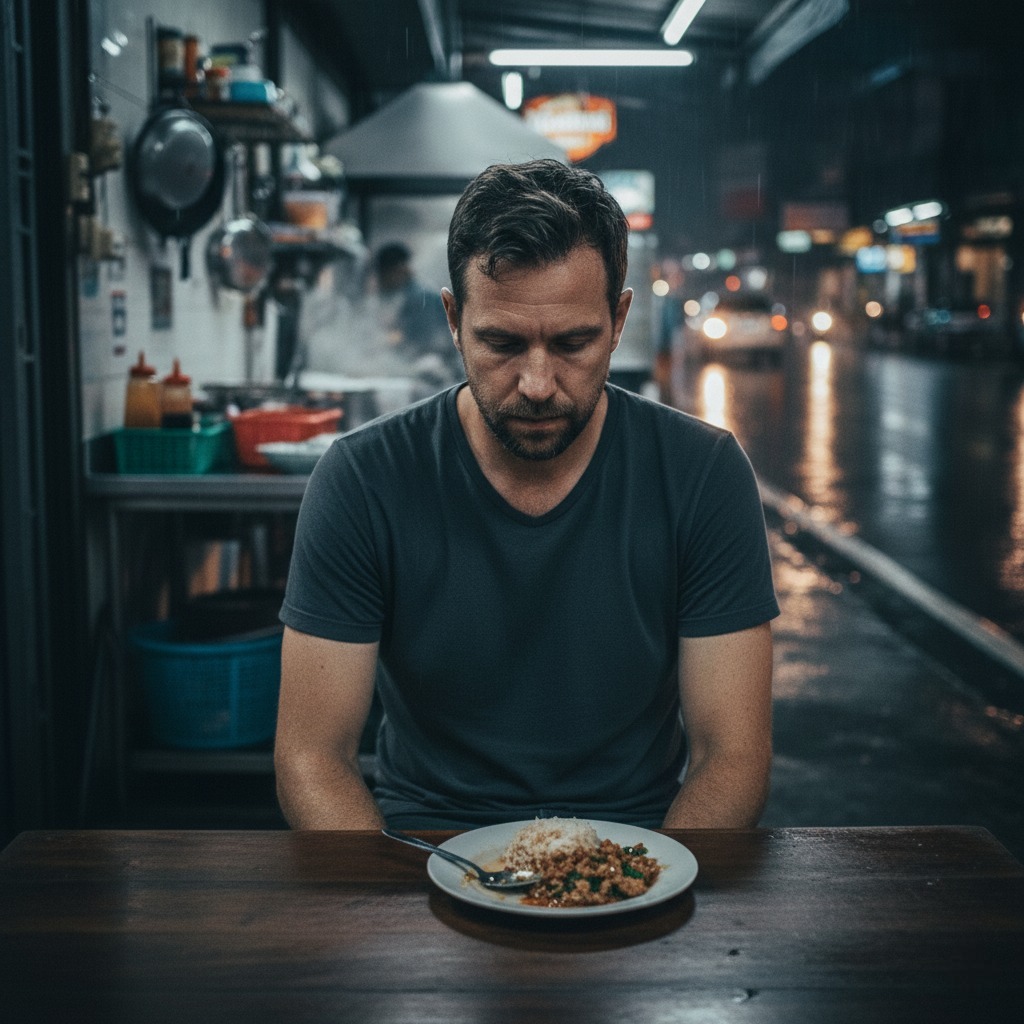
Four days ago, I was living in a party hostel directly across the street from Ao Nang beach in Krabi. I had decided to move. The hostel’s common area had no power outlets for my laptop, and more pressingly, the neighbourhood was a culinary desert, a tourist-centric bubble with not a single authentic, affordable local restaurant in sight.
My quest led me on a 34-minute walk to a small eatery, a place with dishes as low as 60 baht. It was a rare find: local food, local prices. Most importantly, it had a Google Maps rating of 4.9 stars—a near-perfect statistical guarantee against disappointment.
Yet, I left utterly disappointed. I walked out into the rain with a still half-empty stomach and ended up eating a microwaved meal from a 7-Eleven, just to have something before I slept. Fueled by the profound letdown, I did what we digital-age creatures do: I channeled my disillusionment into a Google Maps review.
Having been to Thailand for more than a dozen times and having been to more than 20 cities and town in Thailand, this single one meal here in this restaurant was one of my worst meals in this country ever.
It rarely happens at a 4.9 Star restaurant. Perhaps it’s because of being in the tourist area.
Some of the dishes are a bit beyond local prices. Fried eggs are 15 bahts each while all Thai local restaurants offer 10-baht fried eggs. But that’s not the main point.
The main point is that the portion was only half the normal. I had to look for another meal in another restaurant under the rain.
Plus it’s not really delicious. I have had more than 100 times of the same dish (ผัดกระเพราหมู) and I know the difference.
Maybe they are enough for foreigners who don’t taste Thai food often. But for me it’s quite a disaster. I spent all my years trying to do expectation management with the review data I can find, and I had an epic failure here. It hurts.
She didn’t even look at me when she collected her bill from me, like I was non-existent, just another machine delivering her well-deserved bahts.
This is a restaurant which cooked without heart, served without heart, and even collected the bill without heart.
I made a point of not mentioning the sad 7-Eleven meal; it felt like a personal detail too heavy, too unfair to lay at their feet. It was nearly 10 PM. Finding another local spot at that hour would have been its own ordeal.
An email from Google arrived. The owner had replied.
ขอบคุณสำหรับรีวิวค่ะ จากการสอบถามเบื้องต้นคุณแม่ของฉันต้อนรับคุณอย่างดี คุณถามเรื่องไข่ดาวนั้นในใบเมนูเขียนราคาชัดเจนทั้งนี้ลูกค้าสามารถพิจารณาได้ ทางร้านได้ปรับราคาไข่ เนื่องจากใช้วัตถุดิบในปัจจุบันมีราคาสูงขึ้น เราเลือกไข่ไก่เบอร์ใหญ่ขึ้น บางทีคุณควรทราบว่าไข่ไก่มีหลายขนาดตามราคาตั้งแต่เบอร์ 0-5 เพราะเราเลือกคุณภาพไข่อย่างดี ในเมื่อไข่ดาวทอดออกมาคุณก็ไม่รู้หรอกว่าไข่ดาวนั้นเป็นใครเบอร์อะไร บทสรุปคุณก็ไม่เลือกเพิ่มไข่ดาว ซึ่งมันไม่เป็นปัญหาอะไรเลย ดังนั้นคุณมีสิทธิ์เลือกเพราะราคาเราเขียนชัดเจน คุณสอบถามคุณแม่ของฉันคุณแม่ของฉันก็ตอบคุณเรียบร้อย ในการเสิร์ฟอาหารคุณแม่ของฉันยังแนะนำให้คุณรับประทานพร้อมกับพริกน้ำปลาสูตรทางร้าน แม่ของฉันบอกว่าคุณยังขอบคุณแม่ของฉันอยู่เลย แม่ของฉันถามว่าคุณต้องการเครื่องดื่มอะไรไหมคุณบอกว่าไม่ต้องการ เรามีน้ำฟรีบริการและแน่นอนว่าเป็นน้ำดื่มอย่างดีจากโรงผลิตน้ำดื่ม ระหว่างรับประทานคุณหันหลังให้แม่ของฉันแม่ของฉันไม่สามารถจะชวนคุณคุยได้ และดูเหมือนคุณก็มีโลกส่วนตัวของตัวเอง แม่ของฉันอายุเยอะจะ60แล้วนะ แต่นั่นก็ไม่ใช่ประเด็น ในระหว่างนั้นแม่ของฉันหยิบจับงานอื่นทำ จนถึงช่วงจะคิดเงินคุณแม่ของฉันกำลังล้างจานอยู่ในครัว และออกมาเก็บเงินคุณ คุณเดินมาจ่ายเงินถึงหน้าครัว โดยกะเพราหมูสับราดข้าว 60฿ แม่ของฉันบอกว่าได้สอบถามคุณว่าอร่อยไหมคุณบอกว่าโอเค แม่ของฉันจำได้ว่าคุณรับประทานข้าวจนเกลี้ยงจาน แม่ของฉันยังบอกอยู่เลยว่าคุณกินดีมาก ดีใจที่คุณกินหมด หลังจากรับเงินแม่ของฉันก็ขอบคุณคุณ ในกรณีของคุณ ฉันคิดว่าคุณอาจจะมาตรฐานสูงเกินไปหน่อยนะ แต่ร้านเราก็เป็นร้านเล็กๆ ราคาก็สมเหตุสมผลในแหล่งท่องเที่ยว ราคา60฿ ซึ่งหาไม่ได้ง่ายๆแล้ว แต่คุณไม่ผิดคุณมีสิทธิ์ออกเสียงคุณมีความคิดเห็นและฉันก็มีสิทธิ์ที่จะอธิบายได้ด้วยเหมือนกัน แต่จากการที่ฉันเห็นคุณรีวิวนั้น คุณไม่เคยพึงพอใจกับสิ่งใดเลย ไม่เพียงร้านของฉันหรือทุกๆที่ที่คุณไป คุณมักจะคิดลบอยู่และตำหนิผู้อื่นเสมอ คุณไม่ได้เปิดกว้างหรือปล่อยใจกับวิถีชีวิตอันสวยงาม เหมือนกับทุกสิ่งไม่ได้ดั่งใจคุณ ทั้งที่คุณเป็นคนเลือกและตัดสินใจเอง คุณอยากได้สิ่งที่ดีที่สุดสำหรับตัวเองแต่บางครั้งคุณก็ไม่พร้อมที่จะจ่าย ถูกและดีมันมีอยู่นะ แต่ก็อาจจะไม่ดีที่สุดสำหรับคุณอีก เงิน60฿ ที่คุณจ่ายไปในครั้งนี้ ฉันคิดว่าคุ้มนะในการที่คุณได้ปลดปล่อยตัวเองออกมา บางครั้งการอยู่บ้านทบทวนตัวเองอาจจะเป็นตัวเลือกที่ดีสำหรับคุณที่สุด และฉันเชื่อว่าจะดีมากๆกับคนอื่นเช่นกัน
English translation: Thank you for your review. From our initial inquiry, my mother welcomed you warmly. Regarding the fried egg, the menu clearly shows the price, so customers can decide for themselves. We adjusted the egg price because ingredient costs have risen; we now use larger eggs. You should know eggs come in several sizes priced from 0 to 5, and we choose high-quality eggs. Once a fried egg is served, you cannot tell its size by looking at it, and in the end you chose not to add an extra fried egg, which is not a problem at all. You have the right to choose because our prices are clearly listed. You asked my mother questions and she answered you politely. When serving the food, my mother recommended eating it with our restaurant’s fish sauce and chili mix. My mother said you thanked her. She asked if you wanted a drink and you said no. We provide free water, and it is bottled drinking water from a proper producer. While eating, you turned your back on my mother. She couldn’t talk to you, and it seemed like you had your own world. My mother is elderly, nearly 60, but that’s not the issue. During your visit she was doing other tasks, and when it was time to pay she was washing dishes in the kitchen and then came out to collect payment. You came to pay at the kitchen counter for the basil minced-pork on rice priced at 60฿. My mother asked if it was tasty and you replied it was okay. My mother remembers you cleared your plate and said you ate very well; she was glad you finished everything. After receiving the payment my mother thanked you. In your case, I think your standards may be a bit high, but our shop is small and our prices are reasonable for a tourist area. Sixty baht is not easy to find these days. You are not wrong; you have the right to voice your opinion, and I have the right to explain as well. From what I saw in your review, you are never satisfied with anything, not just at my place but everywhere you go. You often think negatively and criticize others. You are not open or relaxed about the simple beauty of life, as if nothing meets your expectations, even though you are the one who chose and decided. You want the best for yourself but sometimes you are not ready to pay for it. Cheap and good things exist, but they might not be the absolute best for you. For the 60฿ you spent this time, I think it was worth it in helping you let go a little. Sometimes staying home and reflecting might be the best choice for you, and I believe that would also be good for others.
Reading the novel-length response left me speechless, a whirlwind of conflicting emotions. A story that I had lived had been retold by someone else, and in their version, I was quite a different character. She wrote that I sat with my back to her mother, lost in my own world, as if it were a deliberate act of rudeness, not my only choice to avoid the pouring rain. She claimed her mother had asked me how the food was, a conversation that never happened. She painted me as a chronic complainer, a man impossible to please—a narrative easily constructed, perhaps, by the scarcity of my recent reviews, most of which were now buried in a digital graveyard.
And what of fairness? Could her children, who would always be served with love, ever truly understand the portion size and indifferent service given to a random, anonymous foreigner who wandered in off the street?
Two parallel universes had been born from a single, 60-baht meal. But were the differences even matter? As I scanned the text, a chilling realization dawned on me. She had meticulously refuted things I never claimed and defended things I never attacked, yet my two central points were completely absent. What appears to be a dialogue is often just two people taking turns talking, their words never truly meeting. Each is driven by a hidden logic that pulls us further and further away from the simple fact of our shared humanity.
I went back to my review and added a final thought.
Epilogue:
The owner has since replied, offering their version of events: a kind mother, a warm exchange, a clean plate. Perhaps that was true, in their eyes. But notice what was missing: no mention of the portion size, no mention of the taste. The two things I actually wrote about never entered their story.
And that is the deeper tragedy. It isn’t about whether my account or theirs was “true.” It’s that our versions never touched. They cared about defending their image; I cared about whether a traveler left full, satisfied, acknowledged. Between those two realities lies a silence that no reply can bridge.
This is what communication has become: everyone redirecting attention elsewhere, no one holding onto the simplest of questions—did the human in front of you eat well, feel welcome, feel seen?
Reading it over, I felt like a tiny human shouting at an indifferent cosmos, a small stone tossed into a vast ocean. The ripples vanished before they even formed. The fault wasn’t with the owner, not really. She was only doing what anyone in her position would do: defending her narrative.
The owner’s final suggestion—that I should go home and self-reflect—did prompt me to do the best of that. What would I have done, if I were in her shoes?
In the quiet of my new room, I played out the scene in my head. The answer that came to me wasn’t complex; it was devastatingly simple. I would have invited him back. I would have cooked him another plate of Pad Krapow, a generous one this time, on the house. Not as an admission of guilt, but as a simple declaration: your satisfaction matters.
My mind, trained to see the world through systems and logic, immediately started running the numbers. The business logic, I thought, would surely argue against such a move. But would it? The food cost of a 60-baht dish is perhaps 20 baht. A double portion, 40. A negligible sum. And the potential gain? The conversion of a one-star critic into a loyal advocate, the silent testimony to a hundred other potential customers that this place is run by someone who cares. The science of human behavior confirms it: such an act of sincere goodwill is the most powerful marketing tool in existence.
The equation was almost beautiful in its elegance. The solution with the most empathy was also the solution with the most optimal business logic.
And yet, I knew, out of a million business owners, not one would do it.
Why? I looked out the window at the quiet street. The question then turned inward, a sharp, uncomfortable probe: Would I do it? If it were my restaurant, my livelihood, my reputation on the line? It’s easy to be noble in theory. But in practice?
And after a moment of honest self-reflection, the answer came. Yes. I would. Not because I’m a better person, but perhaps, just because I’m more human.
The answer wasn’t born from a place of moral superiority, but from a place of weariness. A weariness of the transactional world we’ve built, a world that teaches us to fear being taken advantage of, where every interaction is a negotiation, every person a potential competitor. We’ve been so alienated by the cold calculus of commerce that we’ve forgotten what empathy even feels like; it’s just a word in a textbook.
We chase profit so single-mindedly that we can no longer see the most profitable path of all, just as one who chases happiness will never find it.
This is our time. A world full of people who no longer act like people, but pretend they still are. A world where the most human response is also the most logical solution, yet we’ve all forgotten how to be human enough to see it.