Repo Markdown Aggregator
We often accept this daily friction as normal. We forget that the digital tools we are forced to use silently dictate how we act, what we tolerate, and how we think.
Artifacts is a collection of simple, uncompromising tools I built when I decided to stop accepting the friction. But before a piece of code is written, there is usually a story of why it had to exist.
You are currently reading the story behind tool No. 6.
The Human Is Not a Click: A Manifesto for Human Agency
I wanted to read my own work.
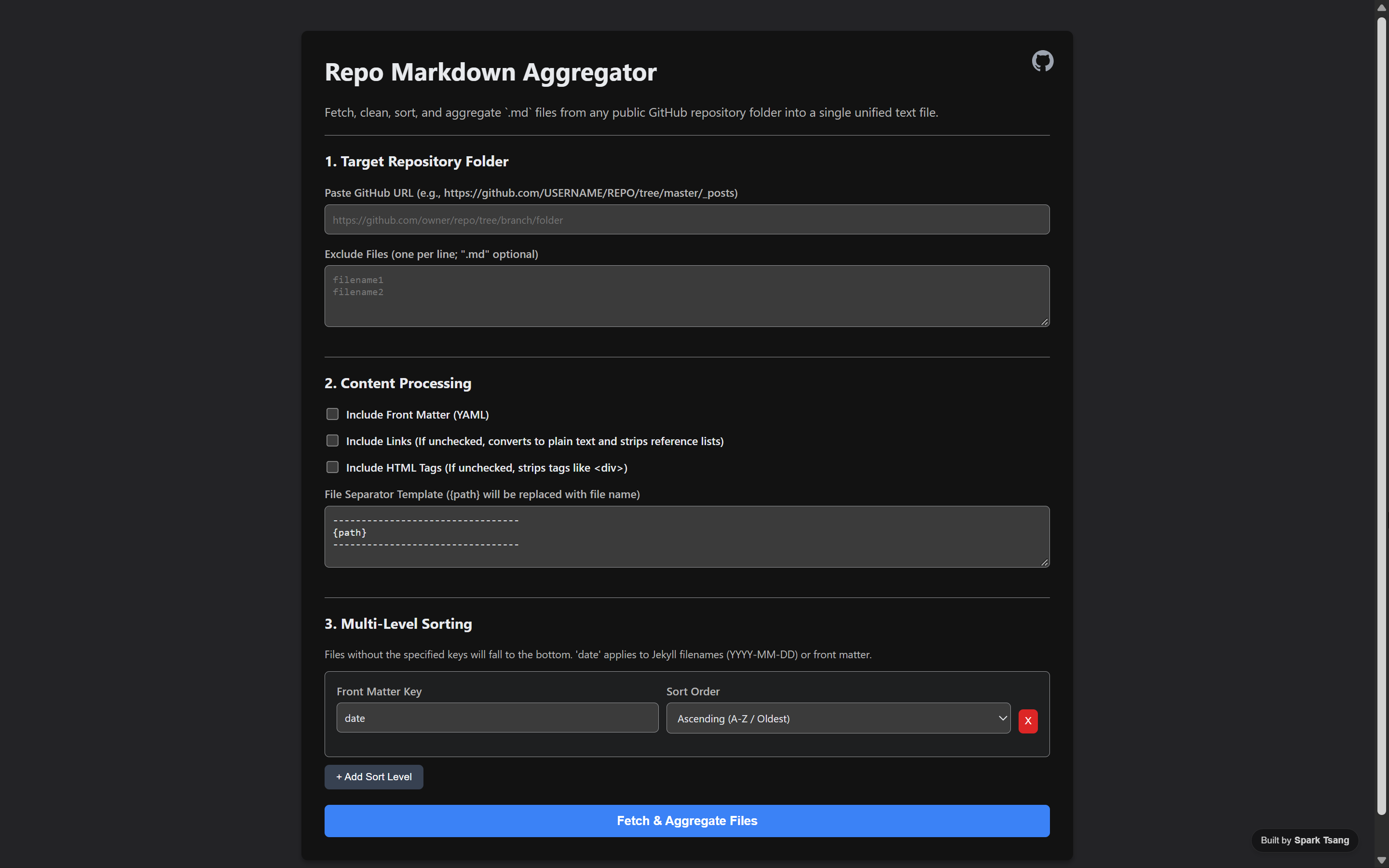
After organizing ninety-three reading notes on my website, I wanted a simple way to retrieve the Markdown files from my GitHub repository, strip away their front matter and hyperlinks, and combine them into a single plain-text document. More importantly, I wanted the files arranged in the exact order in which I had chosen to present them: first by classification, then by their individual order within each classification, with files lacking an assigned order placed afterward, and unclassified files collected at the very end.
It was an elementary file-processing task. I was not asking a machine to understand my writing, interpret its philosophy, or make editorial judgments. I had already made those decisions. I simply wanted the machine to execute them.
I repeatedly asked AI to find an existing solution. Eventually, it gave me one: Uithub.
I went through its verification process, opened the resulting interface, and began looking for the sorting functionality. It was nowhere to be found. Nor could I find a way to strip out the front matter and hyperlinks. The tool could gather the repository, but it could not produce the reading document I wanted.
At first, I thought it was missing a few basic features. Then I realized that the problem was not necessarily the tool. Its purpose was fundamentally different from mine. It was designed to make repository contents accessible in a form useful to machines. I had wanted something designed for a human being to read.
The distinction was almost embarrassingly simple.
The machine could read my repository. But it had not been designed to read it the way I wanted to.
So I built my own.
With a single instruction to AI, I created a customized Markdown Aggregator. It allowed me to control the classification order, the order of individual files, and which files to exclude. I could choose whether to retain front matter and hyperlinks. It would then retrieve the files, process them according to my specifications, and assemble everything into one continuous document.
The machine processed. I curated.
That was all.
And yet, this tiny distinction opened a door to something far more troubling. I began to recognize the same structural reversal everywhere.
Consider the social media feeds through which billions of people encounter the world every day. What appears on your screen is not simply a reflection of what exists, nor necessarily a representation of what you have consciously chosen to see. It is the output of a machine-mediated selection process.
The machine observes what you click, what you watch, what you ignore, and how you interact. It identifies patterns, estimates affinities, and selects what to show you next.
It does not necessarily need to understand you.
It does not need to know why you read something, what it meant to you, what you were trying to discover, or what kind of intellectual experience you are seeking. It may only need to predict that, having interacted with one piece of content, you are statistically more likely to interact with another.
Relevance becomes a substitute for understanding.
Correlation becomes a substitute for knowing a person.
And a behavioural pattern gradually becomes a portrait of a human being.
I have experienced this absurdity firsthand. For an extended period, my Facebook feed showed me virtually no English-language posts, despite my being perfectly capable of reading English. Whatever patterns the system had extracted from my previous interactions, it appeared to have mistaken them for the boundaries of my interests. It had learned something about what I had previously done, but failed to recognize what I was capable of appreciating.
It had mistaken my past for my identity. And then it used that identity to narrow my future.
This is the trap of algorithmic relevance. The machine repeatedly offers things resembling what you have already consumed. You interact with some of them, and those interactions become further evidence for offering you more of the same. The loop reinforces itself.
We navigate this correlation loop like blind climbers searching for higher ground, mistaking a small rise on the callus of a giant’s toe for the summit of the world.
A local optimum is not the summit of the world.
The fact that something resembles what you previously liked does not mean it is what you most need to discover. The fact that a machine can predict your next click does not mean it understands your intellectual ambitions, your aesthetic sensibilities, or the person you might become.
And this logic extends far beyond social media.
Movie recommendations are increasingly mediated by systems that classify films, identify patterns in viewing behaviour, and calculate affinities between content and users. Dating platforms similarly reduce extraordinarily complex human beings into collections of attributes, preferences, and compatibility scores.
There is nothing inherently wrong with calculation. There is nothing inherently wrong with using data to help people discover films or meet potential partners. The problem begins when the mathematical representation becomes a substitute for the person it represents.
A human being is not a collection of tags. A person’s worth cannot be exhausted by a similarity score. And the most meaningful encounter in someone’s life might be precisely the one that their previous behaviour could never have predicted.
The machine knows the pattern. But the pattern is not the person.
Yet we increasingly allow these systems to mediate what we see, what we consider, what we discover, and whom we encounter.
Why? Because the platforms have their own objectives.
A social platform is not simply a neutral window onto the world. It is an environment designed around particular institutional and commercial incentives. Where success depends on retaining attention, increasing engagement, and keeping activity within the platform, the system has reasons to prioritize what sustains those outcomes.
The user’s interests may overlap with the platform’s interests, but they are not necessarily the same.
The platform wants you to stay. It wants you to keep scrolling, clicking, watching, and interacting. Ideally, you never leave. An external link takes you elsewhere. A satisfying discovery may send you away. An independent website may offer something that the platform itself cannot monetize.
The platform’s world becomes a hamster wheel: endlessly replenished, increasingly familiar, and designed around the continuation of the activity itself.
The user supplies the attention. The machine organizes it. The platform captures the value.
And somewhere in this arrangement, the original purpose of technology—to expand human capabilities—has quietly been displaced by another purpose: to optimize the system’s own ability to capture and retain human activity.
This is the contradiction that disturbs me most.
People increasingly fear that artificial intelligence will one day rebel against humanity, seize control of our infrastructure, and imprison us in an artificial reality. We imagine a future resembling The Matrix: machines become conscious, recognize humanity as an obstacle, and take over the world.
But why wait for that future?
We do not need conscious machines to surrender human agency. We do not need a machine uprising, a declaration of war, or a simulated prison.
We only need to keep delegating our decisions, one small convenience at a time.
Let the machine decide what to show us. Let it decide what deserves our attention. Let it decide which ideas are relevant, which films are worth discovering, which people we might want to meet. Let it learn our habits, predict our reactions, and construct an increasingly personalized version of the world around us.
Eventually, we may no longer notice the difference between the world itself and the narrow, algorithmically selected window through which we encounter it.
And the most unsettling part is that nobody needs to force us.
We participate willingly. We return voluntarily. We know that our attention is being measured, that our behaviour is being recorded, and that our preferences are being used to shape what comes next. We recognize many of the compromises, yet continue to accept them because the systems are convenient, familiar, and difficult to leave.
We fear the possibility of machines taking control of humanity while becoming increasingly comfortable with allowing them to control the conditions under which we exercise our own choices.
There is something profoundly self-contradictory about this.
We fear becoming the puppets of machines, yet we are already willing to hand them the strings.
But what would technology look like if it genuinely served human beings?
Imagine a platform that did not primarily seek to maximize the probability of your next click, but to create meaningful encounters between people and ideas.
Imagine opening a feed and discovering something so precisely relevant to a question you have been struggling with that you feel as though your entire life had been preparing you to read that one piece of writing.
And imagine the other side of that encounter. You publish something you have spent years thinking about. Instead of disappearing into an ocean of content, it reaches the people who might genuinely recognize its value—not merely because they have clicked on similar material before, but because it speaks to something they are trying to understand, something they have yet to articulate, or something they have been waiting to encounter.
The resonance between human minds could be amplified on a scale previously unimaginable.
This would require an entirely different philosophy of technological design.
The objective would not simply be to predict behaviour, but to facilitate discovery. Not merely to reinforce existing preferences, but to expand the horizons within which people can form new ones. Not to keep people inside an ecosystem, but to help them find what they are looking for, even when that means leading them elsewhere.
Relevance would remain useful, but it would no longer be mistaken for meaning. Personalization would remain useful, but it would not become a prison constructed from one’s own history. Recommendation would become an invitation rather than a command.
The machine would serve the person’s purposes, not silently replace them with its own.
This is not a rejection of algorithms. It is a rejection of the surrender of human agency.
My Markdown Aggregator is a microscopic demonstration of that alternative.
It retrieves the files. It strips away what I do not want. It follows the classifications and order I have chosen. It assembles the material in the form in which I want to read it.
The machine does not decide what matters to me. It does not infer my intellectual priorities from my previous clicks. It does not substitute its own conception of relevance for my intentions.
I define the structure. The machine executes it.
That should not be a revolutionary proposition. It should be the most elementary principle of engineering.
Yet in an internet increasingly organized around machine-mediated selection, even this simple relationship feels worth defending.
And perhaps this is the real question we should be asking about artificial intelligence—not whether machines will eventually become powerful enough to dominate humanity, but whether humanity will continue to surrender the authorship of its own experience.
A machine can calculate what I am likely to click. It can classify what I have previously liked. It can predict what I might consume next.
But it cannot be allowed to mistake those calculations for the person I am.
The human is not a click. The human is not a profile. The human is not a probability distribution to be optimized.
Technology should expand the range of human agency, not become the author of human experience.
The machine should help us discover the world.
It must never quietly decide the limits of the world we get to experience.
Written on Nov 5, 2026