HK Movie RT Scores
The Cinematic Ballot: An Anatomy of Aesthetic Injustice
There is a persistent, comforting mythology that governs the modern market: the belief that free choice is, by itself, a perfect sorting mechanism—that the invisible hand will naturally reward what is good and discard what is not.
Look at the silver screen, and watch that myth begin to fracture.
Cinema exposes a structural weakness in the market that is easy to overlook: a market can only reward quality if the people making the choices have some meaningful way of distinguishing quality from noise before they pay.
They often do not.
Films of little intellectual, emotional, or aesthetic value can command enormous audiences and enormous revenues. Attention generates money; money generates further attention; and the cycle can reproduce itself indefinitely. This is a cultural analogue of Gresham’s Law: signals that are cheap to manufacture, amplify, and sell inevitably crowd out those that demand genuine rigor and craft.
The result is not merely a market failure. It is an aesthetic injustice.
But the real tragedy does not occur in the boardrooms of movie studios. It occurs in the few seconds before an audience member decides what to pay for.
Millions of people enter the cinema under conditions of radical informational asymmetry. They have seen a thirty-second trailer. They have encountered an algorithmically selected clip. They have absorbed a campaign designed to generate urgency, curiosity, identification, or hype. They are then asked to make a decision whose consequences are immediate and whose information is painfully thin.
They watch the film. Perhaps it is excellent. Perhaps it is mediocre. Perhaps it is terrible. Whatever happens, the transaction is complete.
And then the familiar cycle begins again: they endure a terrible film, complain bitterly about the death of cinema, and make another purchase under essentially the same blind conditions.
The problem is not that audiences lack taste. The problem is that the market does not automatically produce knowledge.
A market is made of choices. And choices made under noise are not magically transformed into informed choices merely because millions of people make them.
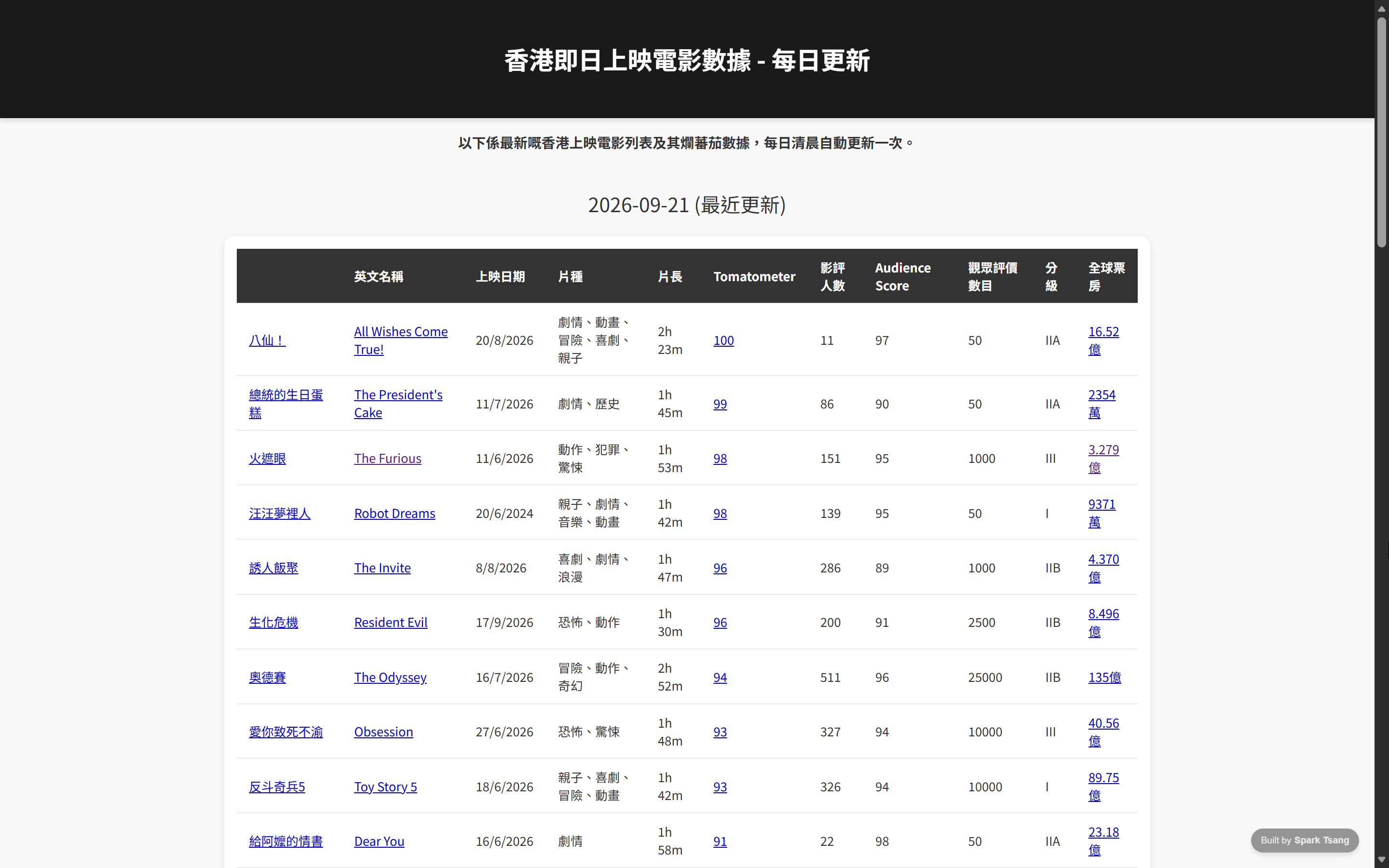
This web application is a deliberately modest intervention in that system. It is a daily index of films currently showing in Hong Kong, distilled into a simple table and ordered by the Tomatometer—from highest to lowest.
That simplicity is intentional. This is not a recommendation engine. It does not attempt to tell you what you should enjoy. It does not promise to predict your emotions. It does not replace judgment.
It inserts one thing between marketing and purchase: a moment of verification.
Rotten Tomatoes is not infallible. No aggregation is. Critics have biases. Consensus can be wrong. Quantification can conceal as much as it reveals. A score is not truth, and this application does not treat it as truth.
It treats it as a signal. And a signal is valuable not because it is flawless, but because it injects actual information into a space otherwise ruled by marketing noise.
The Tomatometer is therefore not a verdict. It is an evidentiary checkpoint: a publicly accessible piece of information that can interrupt the otherwise overwhelming asymmetry between what is being sold and what the consumer actually knows.
You may still choose the poorly reviewed film. You may love a film that critics dislike. You may dislike a film that critics praise.
That is not a failure of the system. It is the entire point.
The purpose is not to eliminate individual judgment, but to make judgment more informed. This requires rejecting another modern cliché: that aesthetic judgment is simply subjective preference and therefore cannot meaningfully be examined.
Personal response is subjective. Quality is not therefore meaningless.
Art can be discussed, compared, criticized, defended, and evaluated against dimensions that extend beyond private taste: writing, structure, direction, performance, coherence, originality, emotional force, craftsmanship, and countless other properties that can at least be investigated intersubjectively.
To deny all of this is to surrender evaluation itself—to reduce every disagreement to preference, and every preference to an equally valid private universe.
Once that happens, evidence disappears. And once evidence disappears, every metric becomes meaningless.
The alternative is not blind faith in numbers. It is a culture of verification. That culture begins with a very small habit: before you consume, look. Before you spend, check.
The market does not magically filter out the weak. The market is composed of the choices we make when we open our wallets. Therefore, a transaction is never merely a transaction.
It is a ballot.
Every dollar, every ticket, every click, every hour of attention is a small allocation of cultural power. It helps determine which stories survive, which filmmakers are funded, which aesthetics are reproduced, and what kind of cultural environment will exist for the people who come after us.
This does not mean turning every purchase into a moral trial. It means recognizing agency.
Your attention is not passive. Your money is not passive. Your consumption is not passive. You are participating in the selection mechanism. The question is whether you are participating blindly.
This application will not save cinema. A spreadsheet will not defeat Hollywood. A rating system will never eliminate bad judgment.
It does something smaller. It places one piece of evidence in front of you at the precise moment when evidence can still change a decision.
That is enough to begin.
If we cannot establish even this most basic form of cultural self-defense—if we refuse to verify anything before we buy it—then we should not be surprised when the market reflects exactly that indifference back at us.
The revolution does not begin in Hollywood.
It begins in the minute before you buy your ticket.
Written on Sep 18, 2026
BACK TO ARTIFACTS